A continuous sequence
All 87 consecutive IDs from the initial print tests through v73 belong to the xinzhai/xz families.
Sequence reviewStrong evidence of a related publishing workflow. Version-labelled bulk uploads overlap with recurring knowledge-labelled posts. What the system does, who operates it and whether agents are involved remain unknown.
Reviewed September 5, 2026. “Xinzhai” is the observed spelling; its intended Chinese name is unconfirmed.
All 87 consecutive IDs from the initial print tests through v73 belong to the xinzhai/xz families.
Sequence reviewxz records interrupt the v71 and v72 uploads between numbered parts. This is stronger evidence of a related workflow than adjacency alone.
Interleaving evidenceAll nine large objects reproduce nested Base64 and 30,000-character chunks. Their extra encoding layer could protect them from the plus-to-space change seen in the small records.
Encoding reconstructionThree plan posts immediately precede new record sizes in the proposed primary sequence. Another size cohort continues across the latter two changes.
Transition reviewxz_knowledge_p1 records begin at 22:24 while bulk uploading continues.These are source-displayed dates and times, with unresolved timezone and no independent archive dating of the posts. The timeline preserves those displays.
Bulk snapshots plus recurring updates are a plausible interpretation of this pattern. The labels suggest knowledge and planning, but they do not reveal the contents. Recurrence is compatible with automation; it does not distinguish a scheduled script, one agent or a swarm.
Two corrections matter: 30,000 characters is an observed chunk size, not a proven site limit. A Fernet-shaped binary layout is not authenticated encryption evidence or decrypted content.
Stronger attribution would require a client implementation that reproduces this publishing path, readable task or execution evidence, or an independently dated source linking an operator to these specific posts.
Search resumed around persona rescue, release exports, repeated state encryption and ordinary storage helpers. Read the new hypotheses and checked leads →
Seven concrete projects, discussions and public surfaces reviewed, including a source-verified encrypted-state writer and a weak similar-name candidate. Read the new findings →
A memory-and-reflection loop is plausible, and ordinary scheduled state uploads remain a serious alternative. Dated papers and current project examples help explain both. Read the analogues and competing interpretations →
The large uploads strongly fit Fernet. Small xz records fail that layout; their lengths also rule out one fixed wrapper around padded CBC for the whole stream. AES-GCM remains a hypothesis. Read the cryptography analysis and size table →
July archive scan: timestamped status →
Separate inner-encoding copy scan: timestamped status →
The July search checked 2,093,746,605 text records in all 100,000 input files, with no matching labels or copy prefixes. Read the July completion audit.
Two August representation searches checked the same 2,083,525,558 text records, with no matching copy prefixes. Pages can recur across crawls; these counts are not unique webpages. Transformed and unindexed copies remain possible. Read the completion audit.
Public code, README and model-hub searches have not found a matching uploader. Concrete similar-name matches resolve to historical texts, geographic names and finance tools. The alternate Ubuntu hostname serves a matching record, so it is not an independent occurrence.
Gitee and GitCode browser project search are accessible from the existing server. They do not provide demonstrated global source-code coverage. Geographic infrastructure alone has not been shown to solve those index and feature limits. See the access comparison.
Download the working overview as text
Leading explanation
Treat xinzhai and xz as one related publishing workflow. Its visible lifecycle is consistent with bulk state uploads plus recurring smaller records, followed by configuration or state changes. The evidence for that grouping is strong. The contents, actual software, operator identity and involvement of research agents remain unresolved. The case is worth following because of its concrete behavior, not merely its Chinese host or name.
Three record families
1. xinzhai: three readable print tests and76 pieces assembling into nine version-labelled large objects. All reproduce double Base64 followed by30,000-character chunking. The inner binary objects match Fernet layout, without authentication or decryption.
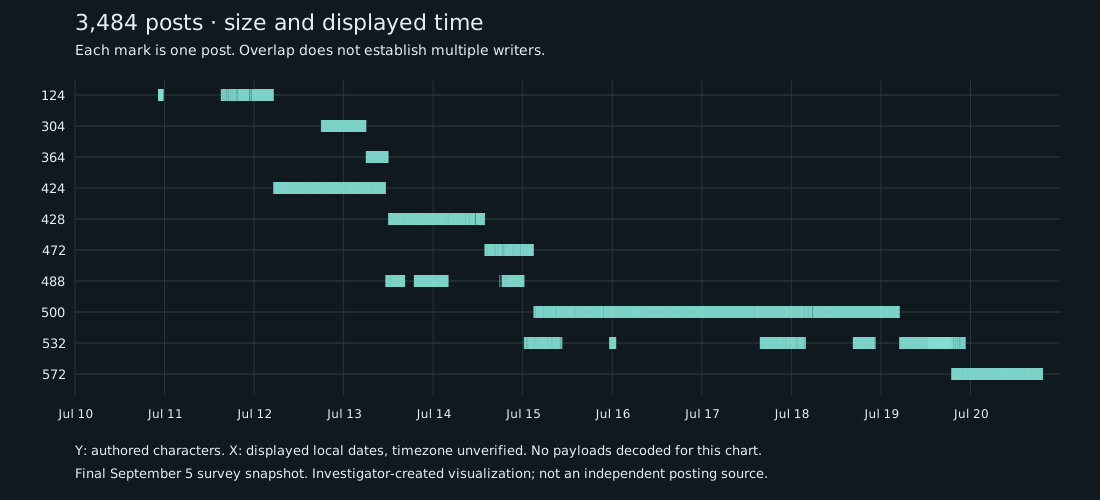
2. xz_knowledge_p1:3,484 distinct opaque records, source-displayed July10–20, ten binary sizes and strong recurring timing.
3. xz_improvement_plan_p1:11 distinct opaque records. First five646 bytes, remaining six647 bytes; all864 encoded characters. Initial six-hour timing later becomes irregular.
Strongest evidence of connection
- Every one of87 consecutive paste IDs from the initial xinzhai tests through v73 belongs to xinzhai/xz.
- Small records interrupt multipart uploads at internal part boundaries, then continue after the bulk uploads end.
- The extra encoding layer on large objects explains why a shared plus-damaging submission path could leave large posts intact while changing plus signs in small records to spaces.
- Plan posts immediately precede all three transitions in the proposed124->424->488->532-character knowledge lineage. Another size cohort continues across the latter two transitions.
- The plan binary length itself changes646->647 at the middle of those three boundaries.
Compact lifecycle (all dates are source displays)
July10 21:26: print tests begin.
21:27–22:44: nine large groups appear; labels include v5.2,v52,v60,v61,v70,v71,v72,v73.
22:24: small knowledge stream begins during the bulk sequence.
22:30–23:35: two distinct small records at each of14 five-minute slots.
July11 15:11: small stream resumes after936minutes, with single displayed-minute records.
July12 05:12: first plan; knowledge size changes124->424 between05:10 and05:15.
July12 18:02: second size cohort joins the recurring stream.
July13 11:17: plan grows by one binary byte; knowledge424->488 follows at11:18 while secondary cohort continues.
July15 00:24: plan immediately precedes knowledge488->532; secondary cohort continues.
July20 19:20: final observed knowledge record. Later validated pages through September5 do not show a continuation of the same short, space-damaged shape.
Completed hidden-length audit
All3,484 rows from056 were grouped by authored character length and independently measured decoded length. Every knowledge character cohort has exactly one binary length:124->93 (178posts),304->226 (143),364->271 (71),424->316 (358),428->319 (300),472->352 (146),488->364 (239),500->374 (1,153),532->397 (605),572->428 (291).
No hidden within-cohort binary-size variation was found in knowledge records. The plan's646/647 change is therefore a real additional distinction, not a widespread unexamined ambiguity in the knowledge-size timeline. Equal binary size still does not imply equal plaintext or semantics.
Interpretations to keep separate
Observed: names, IDs, lengths, hashes, encoding layers, timing and interleaving.
Strong working inference: shared workflow with recurring record classes.
Plausible mechanism: a bulk snapshot path plus small periodic state records and a maintenance/planning path.
Unproved: small records are deltas, plans improve reasoning, version73 means73snapshots, exact encryption of small records, a common key, multiple agents, a Chinese lab, or escape from an evaluation.
Version labels may be counters or dotless software releases; the explicit v5.2 argues for checking both.30,000 is a client chunking fingerprint, not an established hard site limit.
Next evidence that would materially change the case
A public implementation matching the combined naming/chunking/encoding fingerprint; a readable local explanation connecting these labels; an independent dated occurrence of a distinctive marker; or an authenticated operator statement. Repeated generic agent-product searches, ciphertext uniqueness alone and speculative cipher labels will not settle the question.
Current focused code-search coverage found no matching uploader; authenticated code-search gaps remain. No request to the original service was made to test posting or limits. No keys were sought or used.
Files and reproducibility
066/AgentWorld work is deprioritized by user steering. Relevant primary analyses are067(shared sequence),068(encoding),069(startup pairs),070(client search),071(restart),072(plan coupling),073(hidden plan size), plus028 and055/056 for full measurements.074-private/knowledge-length-audit.json preserves the new grouping and source hash.
The published /posts collection remains a fixed1,142-post export, distinct from the3,484-record reviewed collection. Original and decoded payloads are not republished in this overview.
Local context follow-up075: all4,872authored bodies hash-verified and screened for exact labels, possible Chinese spellings, Fernet and chunk constants. Only the initial xinzhai print test and an unrelated numeric substring matched. No readable uploader explanation found in this lexical scope.
Hostname follow-up 076: paste.ubuntu.com.cn serves an exact copy of a saved org.cn plan record at the same ID, with matching metadata and org.cn navigation. Treat as an alias/shared service or mirror, not an independent occurrence. Follow-up077 found no status-200 Wayback captures for that alternate prefix from July1–September5, with a successful positive control. Independent archive dating remains unresolved.
Commit-message follow-up078: seven GitHub queries, no matching uploader; full knowledge-label query flagged incomplete. Concrete near-matches resolve to Xiaozhu infrastructure, a new-bond reminder and hardware register parsing. Commit messages are not full source-code coverage.
Source-file search079: Sourcegraph public API works with a real code positive control. No uploader found in returned label/hostname matches; broader label searches emitted a limit warning, and a known GitHub namesake repository was absent from the repository lookup. This adds bounded code coverage, not a global absence result.
Implementation follow-up080: combined encoding/chunk-constant code searches found no matching uploader. Direct inspection resolves OpAgent30000 as browser timeouts and AgentScope30000 as shell-output truncation, with Base64 serving images/commands. These are not demonstrations of the observed multipart storage path.
Historical policy evidence081: recovered and digest-verified an August13 Common Crawl robots.txt capture for the alternate hostname. It disallows CCBot, providing a concrete explanation for missing paste-body coverage. This dates a host-policy artifact, not the xinzhai posts. URLscan public searches found no July-onward host records with a working control.
Cross-site suffix check082: no knowledge_p1 or improvement_plan_p1 matches outside Ubuntu in the saved corpus inventory of113,750files across49host directories. Counts include duplicates/metadata and use default text-search behavior; this is bounded cross-site coverage, not unique-post counts or global absence.
Freshness check083 at20:14UTC: two newly listed IDs4552954–4552955 beyond the fixed survey contain readable C++ and no observed xinzhai/xz markers or opaque-record shape. The fixed survey and1,142-post export counts remain unchanged.
Cross-site copy check084: all3,571opaque cluster records hash-verified and screened as original/space-to-plus text against132,140saved paste/wiki files outside Ubuntu. No64-character prefix candidate appeared. This tests literal copies under other labels, with entity/line-wrap/re-encoding limitations.
Transport follow-up085: visible editor uses multipart/form-data; linked JavaScript has no submission encoder. Native form serialization alone does not explain plus-to-space. A malformed custom URL-encoded request or extra decoding remains plausible, not proven. Public issue-search follow-up086 found no matches in three reviewed queries;171bot reports now complete.
Software comparison087: older lordelph/pastebin source shares code2/parent_pid/editor fields, but its form differs from the current host. The inspected handler passes code2 directly toward storage and shows no explicit URL decode. This identifies a generic field convention, not the installed server or xinzhai client.
Chinese project-index follow-up089: Gitee public search is reachable through its normal browser frontend and observed GET backend. xinzhai and xz_knowledge returned0; hypothetical心斋 returned5unrelated project descriptions. This improves access coverage, not uploader attribution; project search is not global source-file search.
Gitee precision follow-up090: quoted/unquoted hostname queries returned identical broad project results; a checked top page lacks the exact hostname. No matching uploader established. Working project-search access does not guarantee literal query semantics or source-file coverage.
Archive copy follow-up092: completed all100,000August corpus files (2,083,525,558text records), with0failures and0literal-prefix candidates for the3,571opaque records. Completion manifest and empty result files verified. No cross-host copy found within this scope; transformed or unindexed copies remain outside coverage. Scan and observer have exited.
Additional index checks093/094: GitCode browser project search works, but signed-out code configuration reports disabled and direct query responses are inconsistent/firewalled. Hugging Face card/app.py full-text search returned no results for both full xz labels with a working control; leading xinzhai result is a verified historical-text namesake. No new uploader or attribution.172bot reports terminal; no active bot wave.
Search precision095: quotedxinzhai returns exactly1Hugging Face indexed document, the verified historical-text namesake, compared with167fuzzy unquoted results. Quoted knowledge_p1 and improvement_plan_p1 also return0with echoed queries and structured empty docs. This narrows index coverage without adding attribution.
GitHub README follow-up096: xinzhai in:readme returned4matches, all source bodies hash-verified: historical text, new-bond calendar and2city lists. Both fullxzlabels returned0with incomplete_results=false. API body truncation was caught and complete raw files recovered. This adds README coverage, excluding forks by default; no uploader join.
Runtime-label follow-up097: source-file co-occurrence searches found no uploader. A concrete Alibaba diagnostic match uses parent_pid for an operating-system parent process, not paste storage. Exact improvement_plan plus b64encode returned0in the checked index; broader patterns produce ordinary development text and limit warnings.
Non-Python chunk follow-up099:3code-index queries allreturnedlimitwarnings;3pinned implementation matches use30000for wait,telemetry orcookie timeouts rather than chunking. No uploader established; language/index coverage remains partial.
ModelScope follow-up100: official unauthenticated GET model/dataset catalog search works from this host. Six label/catalog queries returned0with successful concrete controls for both routes. Browser No content was invalid as a negative because its non-GET search requests were blocked locally. No source-file coverage or attribution established.173bot reports terminal.
ModelScope applications101: public Studios(status=all) and skills catalogs each returned0for the3observed labels, with real positive controls. Both routes accessible here; source files/logs not searched. Current Studioresponse envelope differs fromSDKcomment, so review uses capturedschema.
Inner-representation copy check103 found0candidates across132,140local cross-site files for255variants of9large groups/76pieces. Archive extension106 has completed with0candidates across all100,000files and2,083,525,558text records; manifest/output audit passed. This is a second representation check of the same corpus, not additional unique pages.
Freshness107: at21:40UTC the source listing remains at4552955, no new bodies fetched. July extension111 completed all100,000files and2,093,746,605records with0matches0failed; exact manifest coverage and empty candidate outputs audited. It combined labels and both copy representations across theJuly10–23crawl. This distinct crawl can repeat August pages; do not sum counts as unique documents. See july-copy-status.html for reviewed completion.
Crypto audit118: all9large groups fit Fernet layout,9distinctIVs,no repeated16-byte ciphertext blocks across77644blocks. Conditional standardFernet plaintext lengths64912–64927bytes initially to231152–231167final. Smallknowledge mod16 residues0,2,6,12,13,15;plans6/7, so no singleconstantwrapper+paddedCBC model fits eitherfullstream. NonehasFernetlengthresidue9. Hypotheticalnonce12+tag16 impliesknowledge65–400bytes andplans618/619, butAESGCMvsChaCha orotherconstruction unresolved. See xz-crypto.html and118report.